

OneDot61 works with Labyrinth on a commercial basis.
Assume a Breach: Why the Most Dangerous Attackers are Already Inside Your Network.
The security industry has spent decades focused on keeping attackers out: firewalls, endpoint protection, email filtering, multi-factor authentication. All of it is designed to stop malicious actors at the boundary. And yet, breach after breach, the pattern is the same: the attacker got in, moved laterally for days or weeks, and caused significant damage before anyone noticed.
The hard truth is that determined adversaries, whether nation-state actors, ransomware operators, or malicious insiders, will eventually find a way past the perimeter. Labyrinth addresses the questions other approaches can't answer: How do you detect a breach that's bypassed your other security undetected and what do you do about it? A prepared organisation has plan for a breach. See the Labyrinth case studies
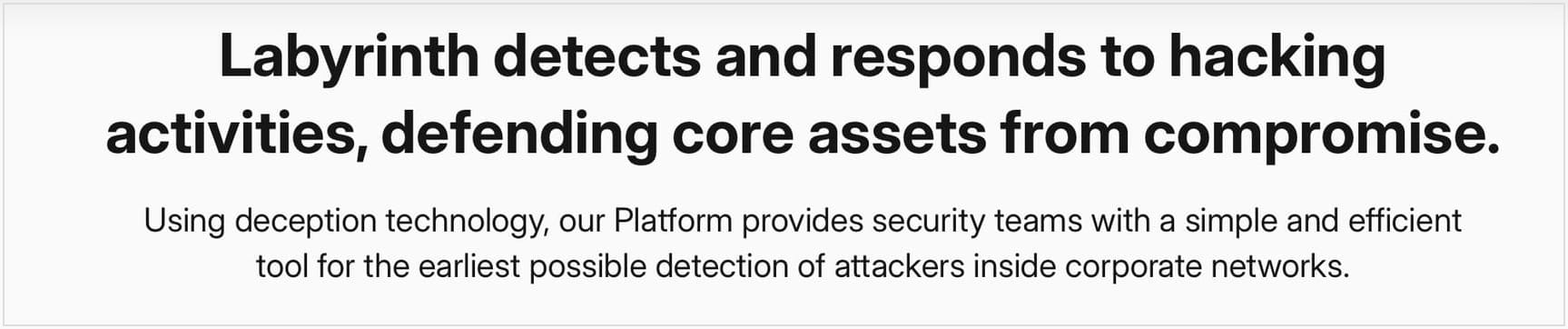
The Dwell Time Problem. How Long Does a Network Intruder Remain Undetected? Labyrinth Detects Intruders Early.
Industry data consistently shows that the average time between initial compromise and detection is measured in days, not hours. During that window, attackers are doing exactly what you'd expect: mapping the network, escalating privileges, identifying valuable data, and establishing persistence. The longer they go undetected, the more damage they can do. Use Labyrinth's platform to achieve early detection
Traditional security tools are largely blind to this phase. Endpoint detection looks at individual devices. SIEM correlates log data. Neither is designed to catch the subtle behavioural signals of an attacker who has already gained legitimate-looking access and is moving carefully through the network. With Labyrinth's platform you can get early detection, investigation, involvement, response and attack validation. See the case studies.
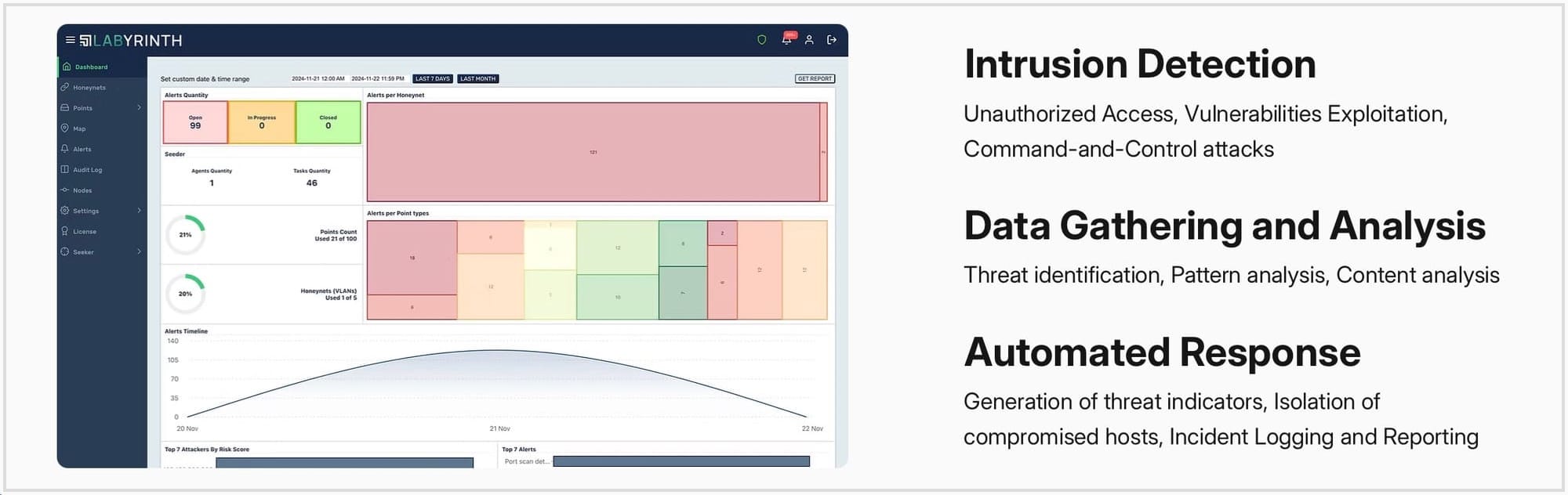
Labyrinth Makes the Network a Trap Using Deception and Decoys to Detect and Deal with Intruders.
Labyrinth uses cyber deception to flip the dynamic. Rather than trying to detect the attacker after the fact, it plants realistic decoys such as fake systems, credentials, and data throughout the corporate network. These assets look legitimate to anyone traversing the network, but they serve no purpose for authorised users. Any interaction with them is an immediate, high-confidence signal of malicious activity. Labyrinth's preemptive security approach can deliver early detection, disrupt malicious activity earlier and allow a rapid response to minimise damage.
Because legitimate users have no reason to touch deceptive assets, alert noise is virtually eliminated. Every alert Labyrinth generates is meaningful. Security teams get early warning of lateral movement and internal reconnaissance which is exactly the activity that precedes the most damaging phases of a breach. See the Labyrinth case studies.
For organisations that have invested heavily in keeping attackers out, Labyrinth's platform addresses the question that other security solutions can't answer: what are you doing when an intruder gets into your network?
